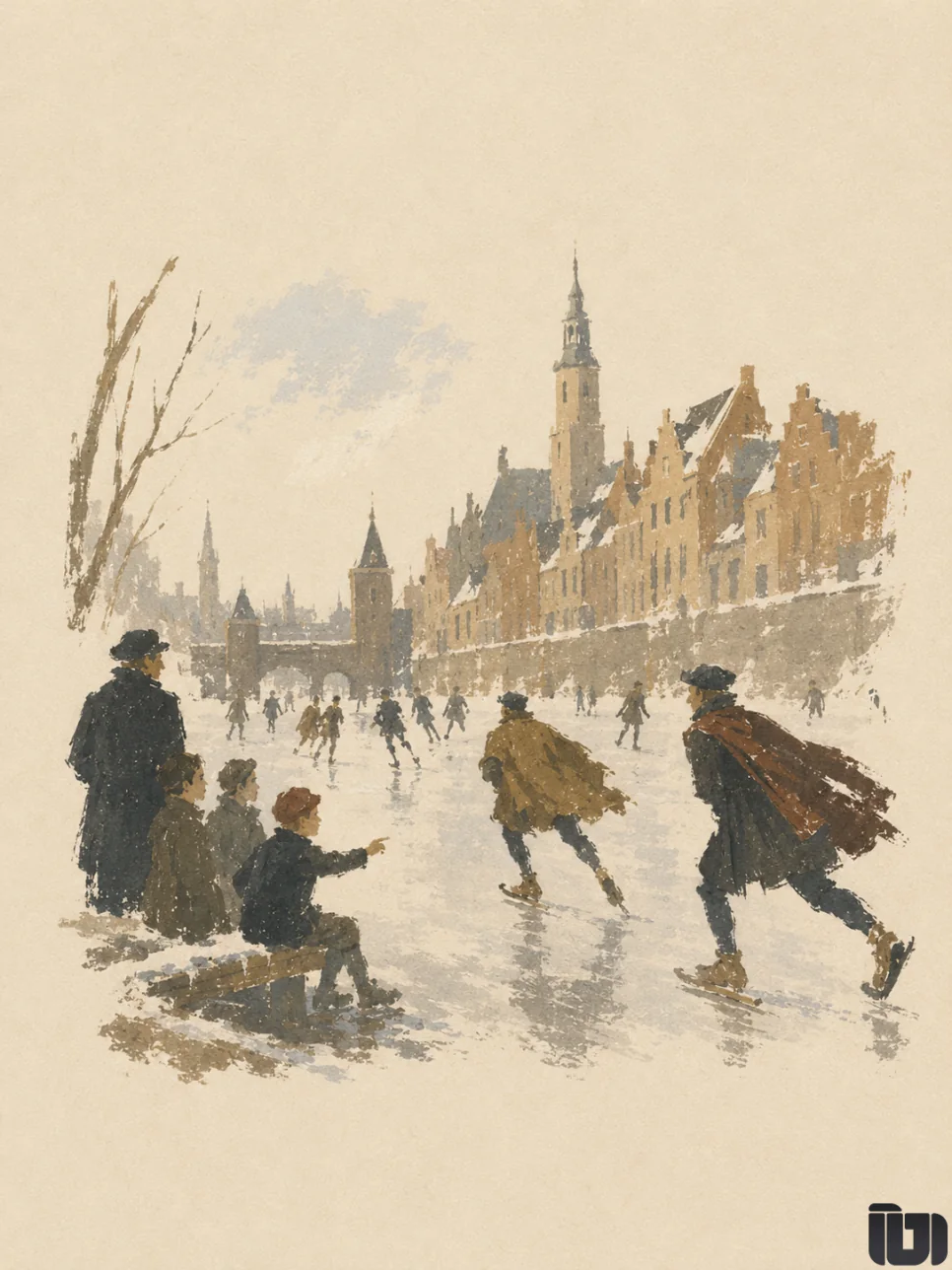
How do Flemish people navigate ice? Ask Benedetto Portinari.
Writing a Person’s Name Beside the Question
This sentence remains in Leonardo da Vinci's notes:
Flanders was far from the part of Italy where Leonardo lived. The region covered parts of present-day Belgium and the Netherlands.
Da Vinci was curious about how the people there got around on the ice.
Leonardo did more than note his curiosity.
He also wrote the name of someone who might know the answer.
Benedetto Portinari came from a merchant family with deep ties to Flanders. Da Vinci wanted to ask him about stories from distant places.
A List of Things to Learn in Milan
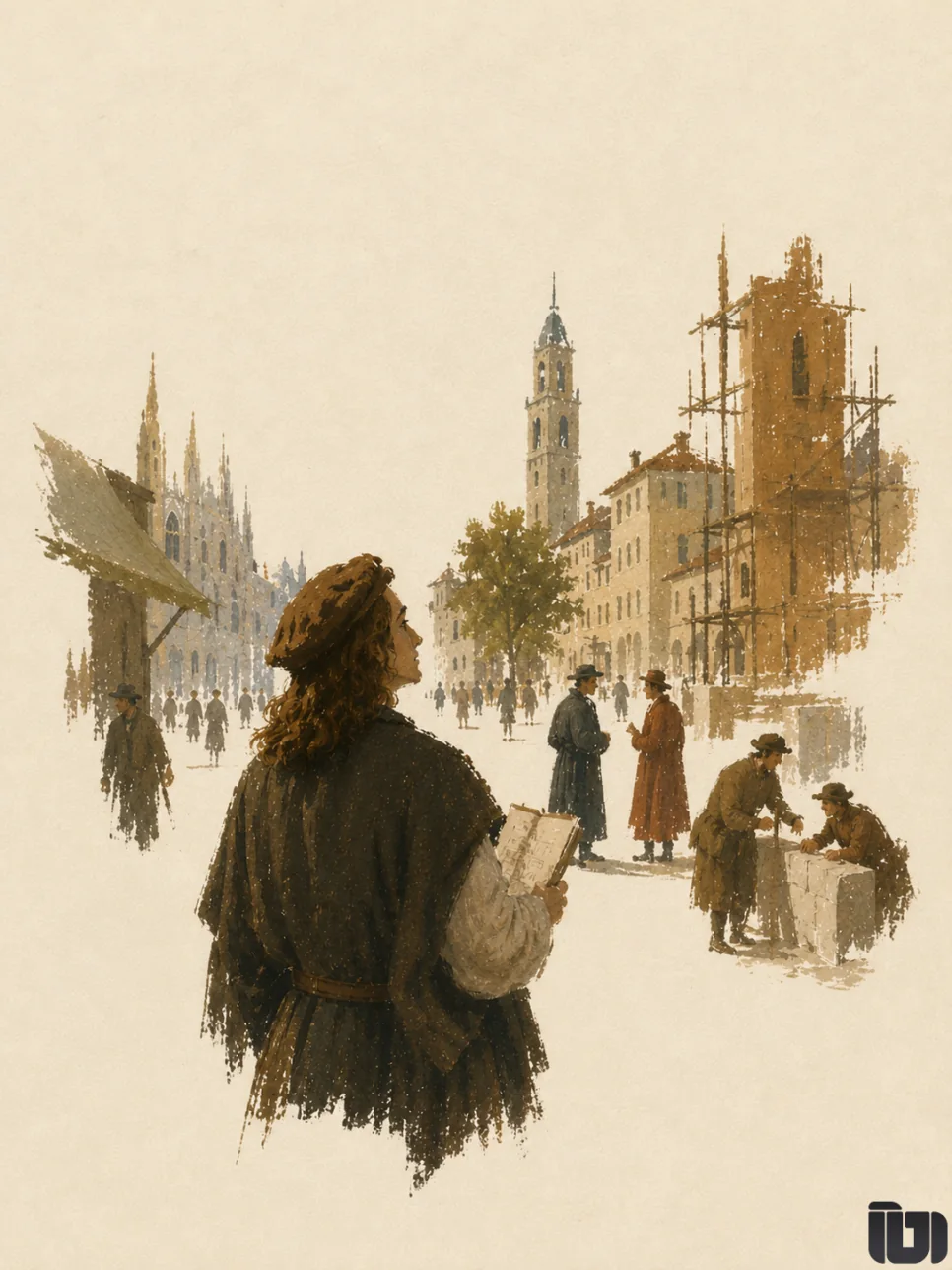
Around 1490, da Vinci was working in Milan, Italy.
There is a long list of things to find out in the list he left behind.
Measure the size of Milan and the surrounding area. Milan and its churches Get a book on the topic from a bookstore. For those who are good at calculating Learn how to calculate shapes. What about the tower in Ferrara? Ask Giovannino if it was built. Draw a picture of Milan yourself.
The list was a mixture of places and books, calculations and architectural stories. Next to them, the names of booksellers, scholars, engineers, and merchants also appeared.
Da Vinci was not just a person who painted pictures.
He asked about cities, buildings, moving water, and the structure of machines. When one subject raised another question, he put that question on paper too.
He did not assume every answer had to come from his own research.
He considered who knew the subject and wrote down a person he could ask.
Tasks Left Between Words and Drawings
On the paper left behind by Da Vinci, text and drawings are seamlessly connected.
He also wrote letters from right to left. When reflected in a mirror, the writing appeared in a familiar direction.
On small notepads, calculations were written next to drawings of machine parts, and in the meantime, books to buy or people to meet appeared.
Today these papers are handed down in several notebooks and large collections.
Among them, the collection called ‘Codex Atlanticus’ contains the largest collection of paintings and writings left by da Vinci.
The notebooks also contain long lists of books, people to ask, things to remember, and work to do.
Turning Questions into Next Actions
Da Vinci's list had more things to check off than complete answers.
He recorded the question, where to look, and who to ask.
One line of questioning leads to the next action.
As you work, there come moments when you cannot find the answer right away.
Sometimes something comes to mind that you need to check with someone, or something you need to ask the next time you meet.
It may seem like you remember it clearly in the moment, but once you start doing other things, the person's name may become blurred, leaving you with questions.
Writing down who you need to talk to next to what you need to do will help clarify your next actions.
Even if you thought about finding out someday, it becomes something you can move on the moment it has a name and a promise.
Whose name could you write next to a question that occurred to you today?
ILJI TIME STORIES · 04